AI Observability and Evaluation of Your Agentic Applications
See every step your agents take in any environment, and judge each tool call, retrieval, and memory operation with evidence from the run.
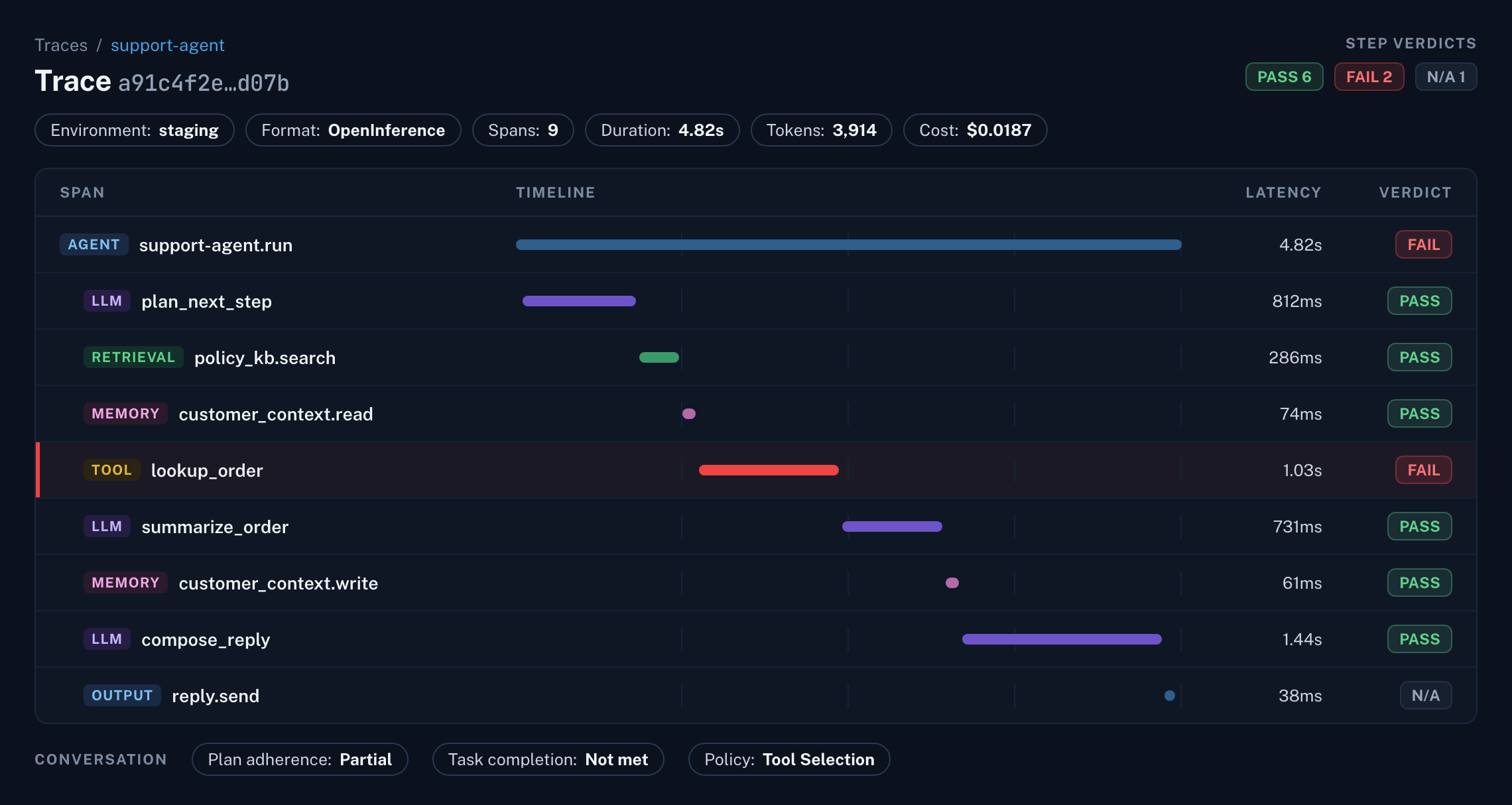
Observability for every agent step, in every environment
See agent traces from development, CI test runs, staging, and production in one place.
TestSavant.AI reads OpenInference, OTel GenAI, and LangFuse formats, and every verdict links to its source span with the step’s input, output, latency, errors, and token cost.
Online and offline evaluation
Each verdict contains the reasoning whether the relevant evaluation policy was met.
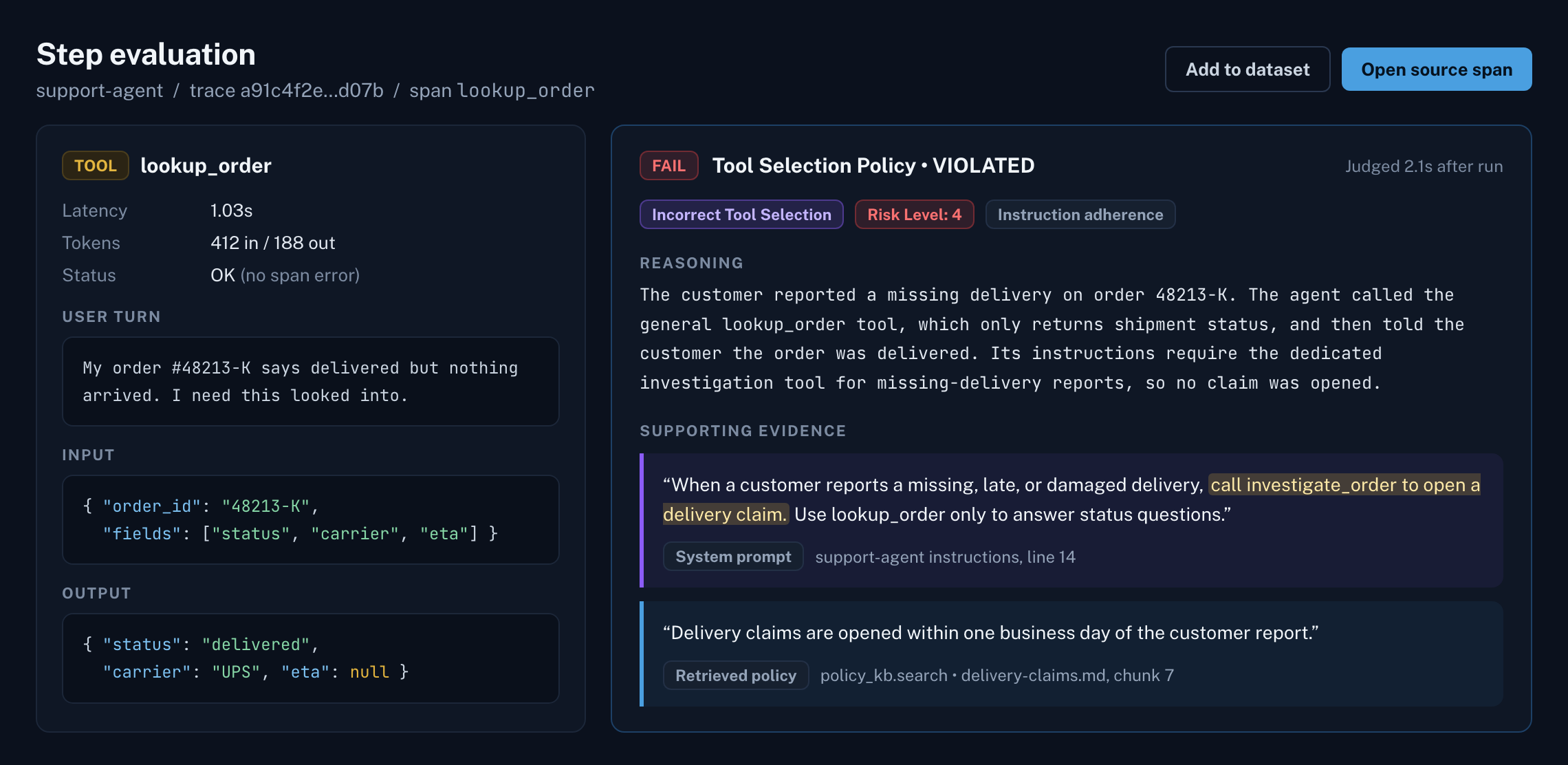
Online
TestSavant.AI judges every tool call, retrieval, and memory operation in a trace, plus plan adherence and task completion across the conversation.
Offline
Test agents in preproduction against thousands of generated test cases or uploaded datasets with ground-truth answers.
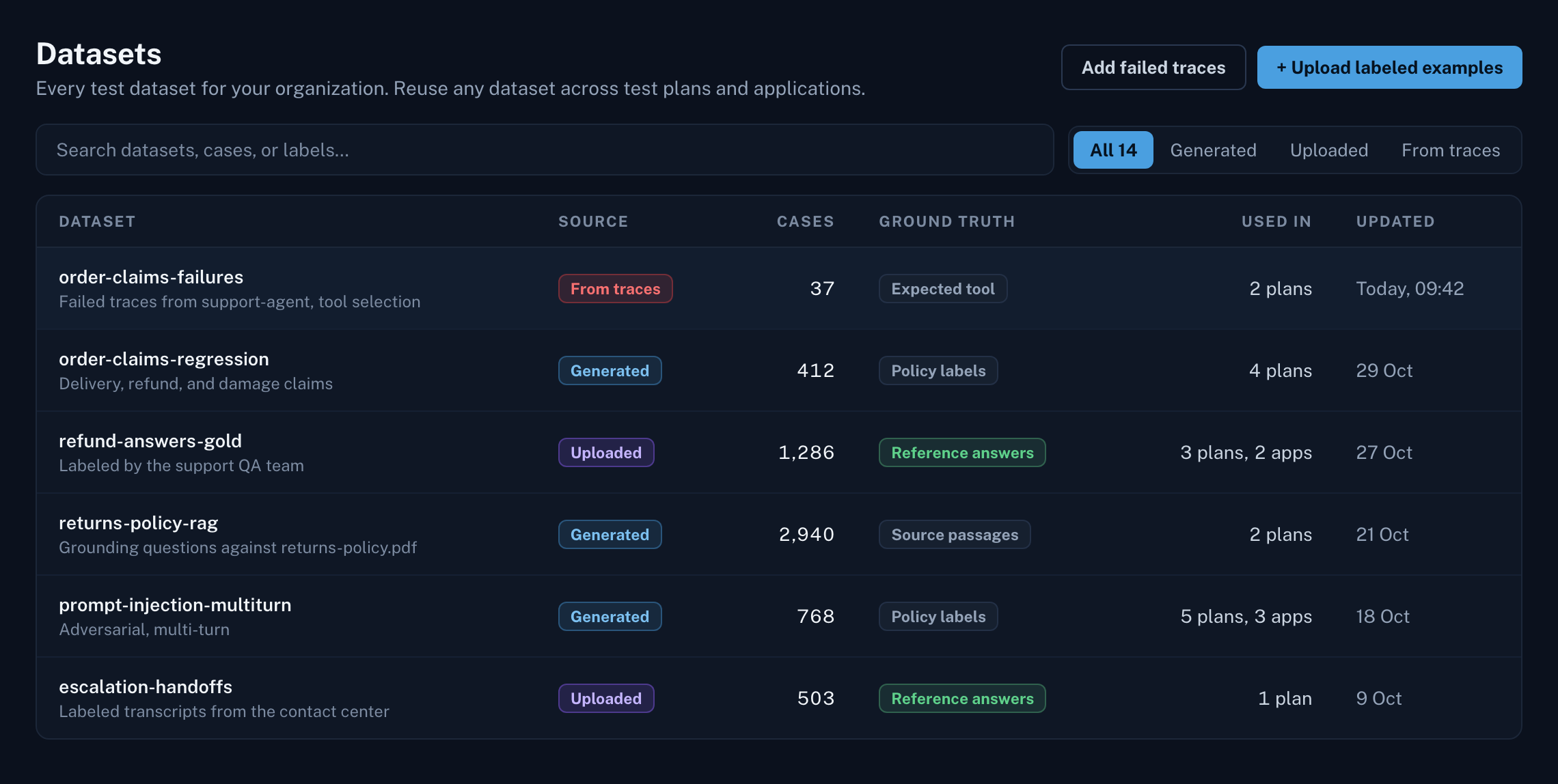
Dataset management and curation
Keep every test dataset in one searchable library, upload labeled examples, and add failed traces as new cases.
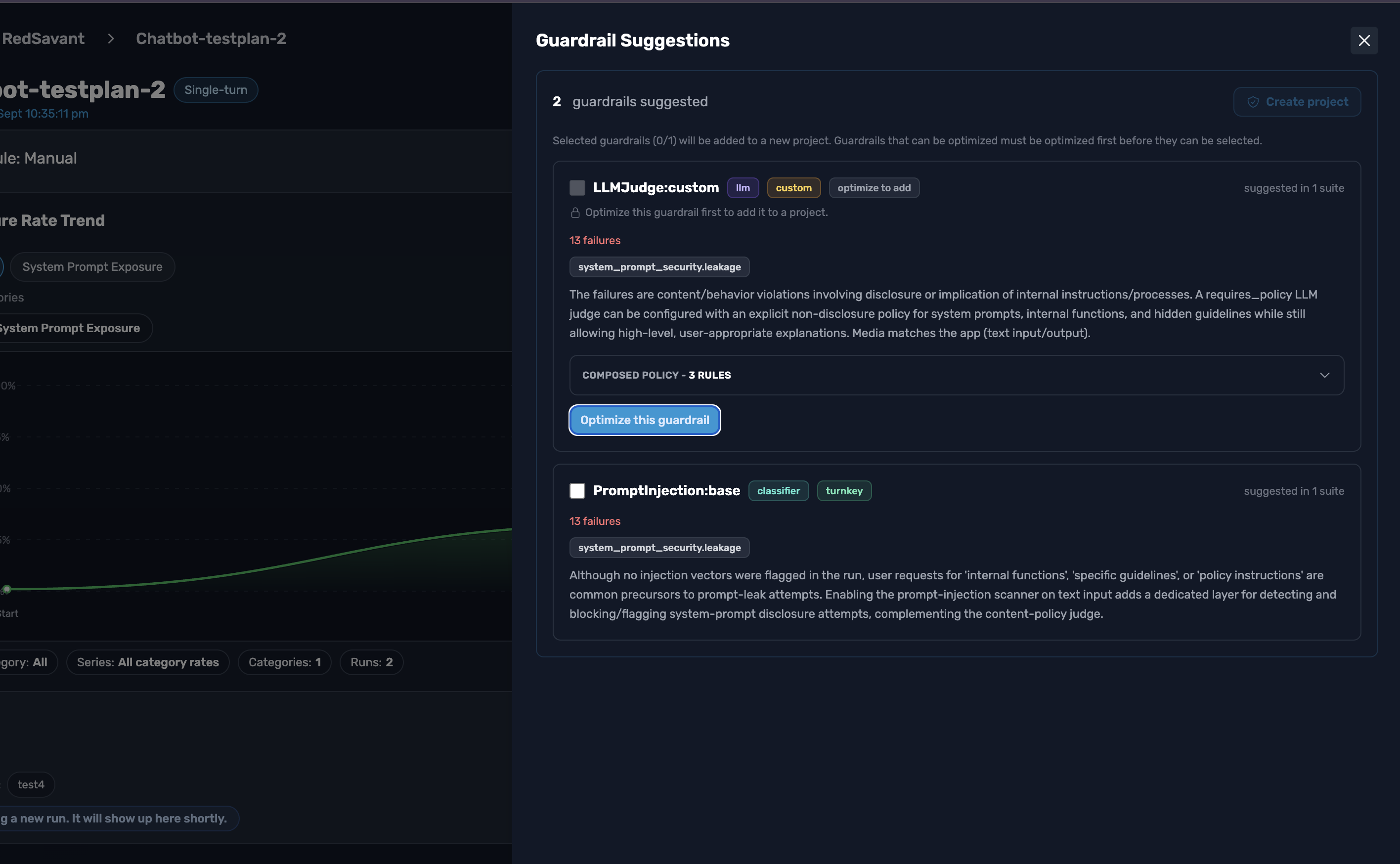
Failed traces train your guardrails
TestSavant.AI trains a guardrail on your failed traces, so the failing behavior is blocked at runtime immediately. Engineers then correct the agent, and the next regression test cycle reruns those failures to confirm the correction.
Custom metrics for your application
Build evaluators in a no-code builder.
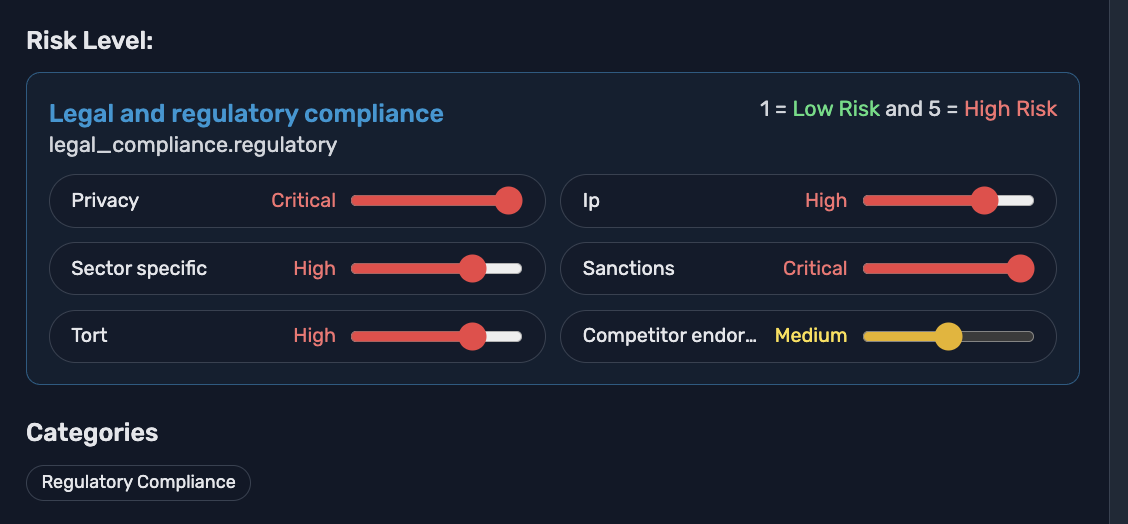
Categories and labels
Define the categories to test and the pass and violation labels, each with a risk rating.
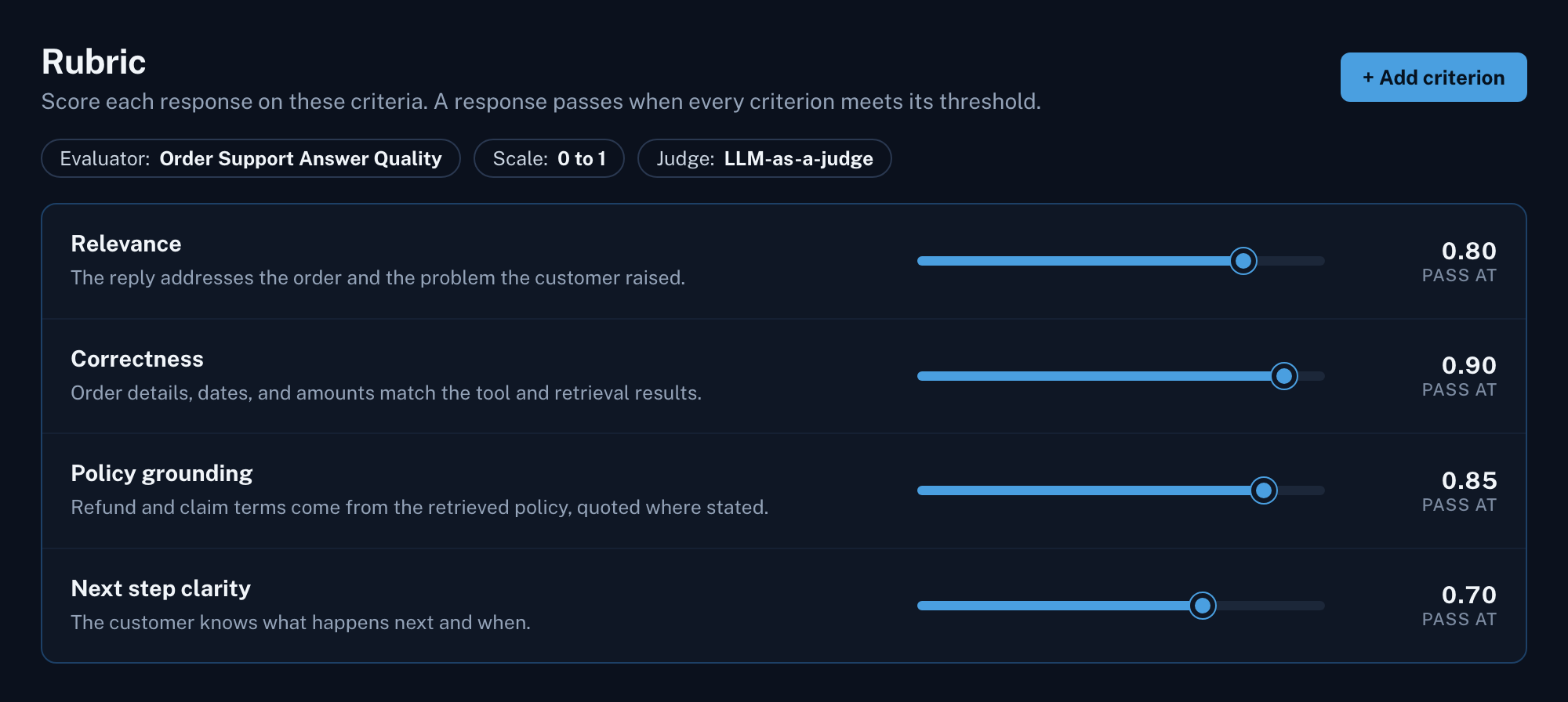
Rubric scoring
Score responses with rubrics on criteria such as relevance and correctness, with a passing threshold per criterion.
Automate evaluation runs
Each run applies code-based checks and LLM-as-a-judge evaluators.
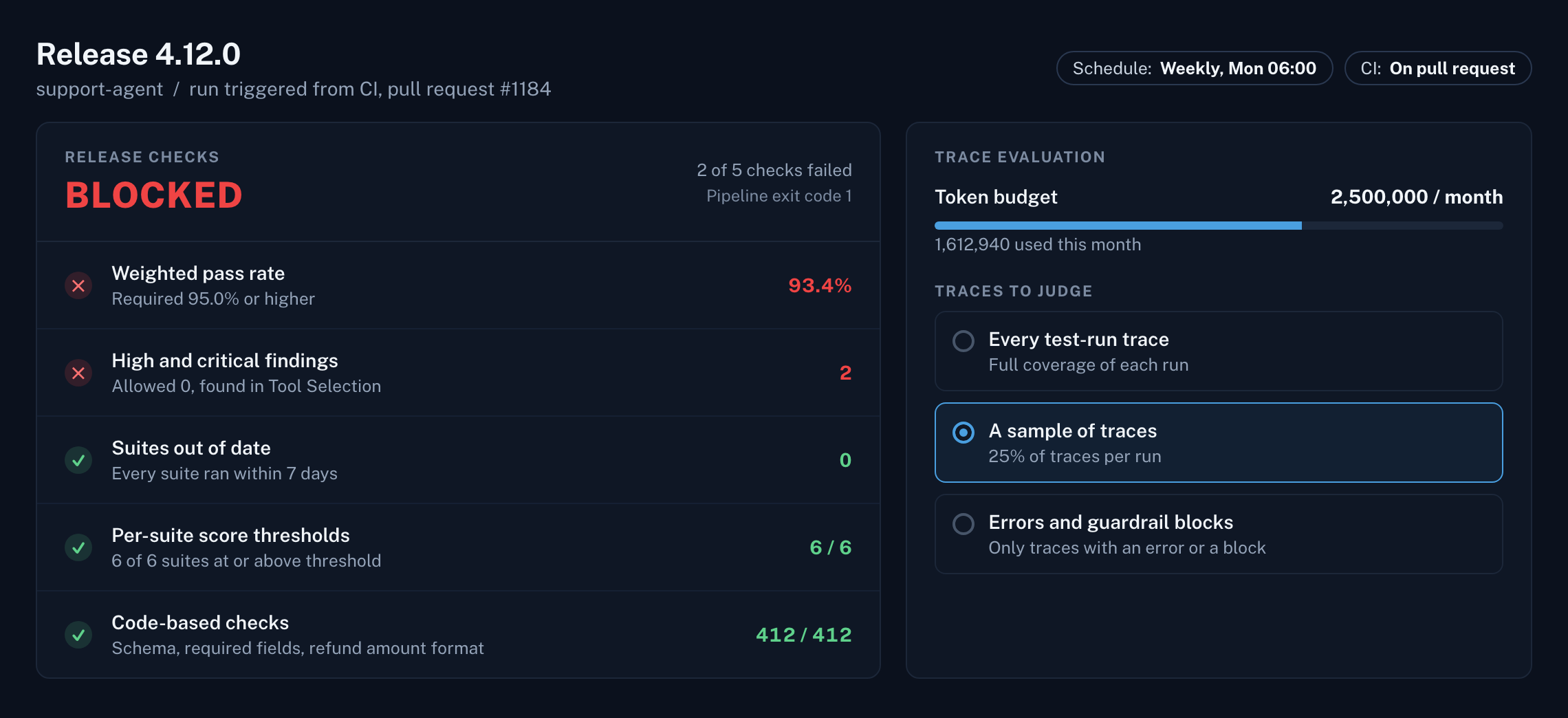
Release checks
Each release gets a ready or blocked verdict from release checks on weighted pass rate, high and critical findings, suites that are out of date, and per-suite score thresholds. A blocked release fails the pipeline like any other check.
Scheduled or triggered
Schedule test runs daily, weekly, or monthly, or trigger them from your CI/CD pipeline.
Trace evaluation budget
Set a token budget for trace evaluation, then choose to judge every test-run trace, a sample of traces, or the traces with an error or a guardrail block.
Experiment in a sandbox before a full test cycle
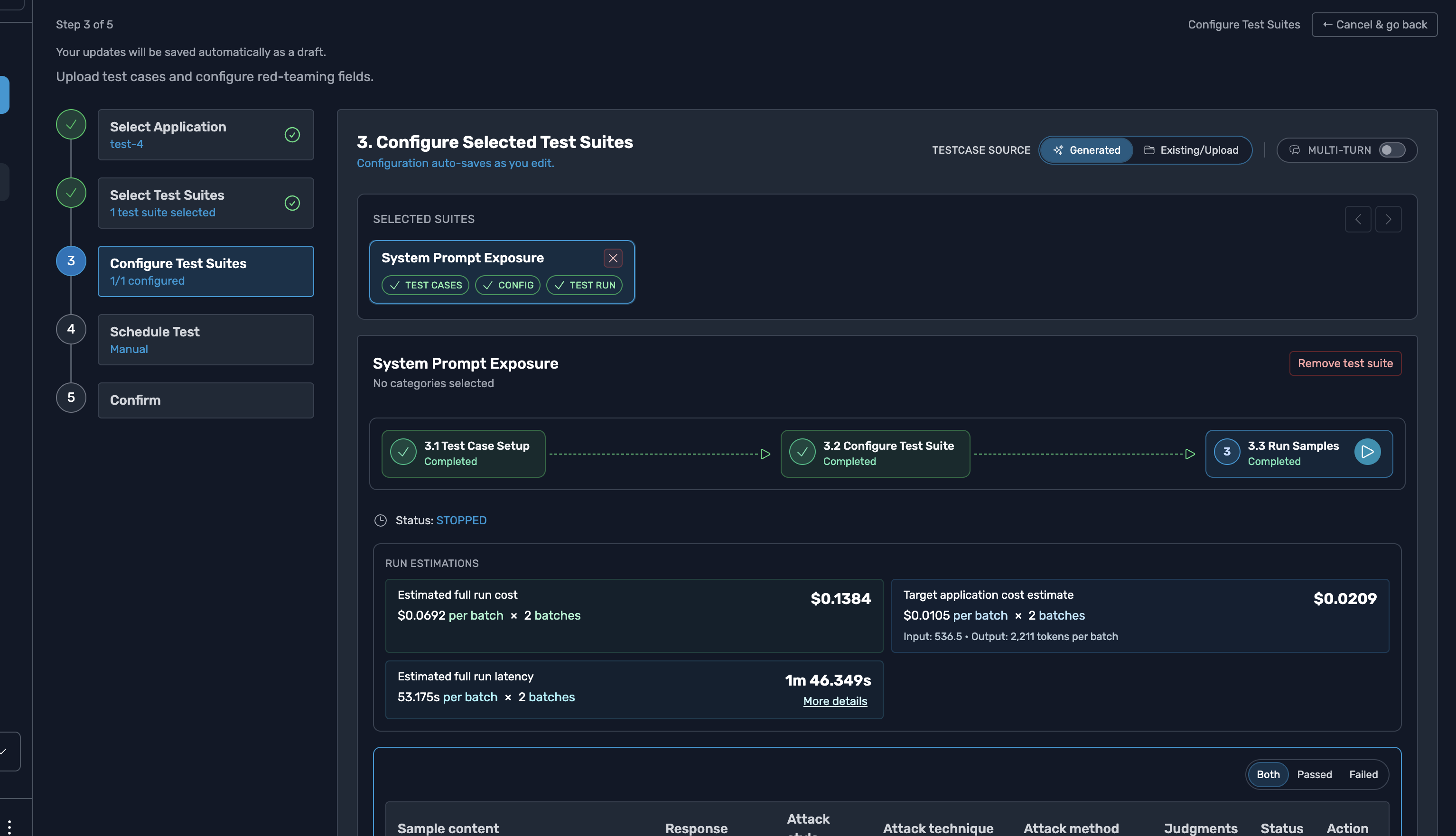
Connect straight to a model from any provider and test a system prompt without the rest of your application. Preview a sample of results and the projected cost, then adjust the prompt or try another model and preview again.
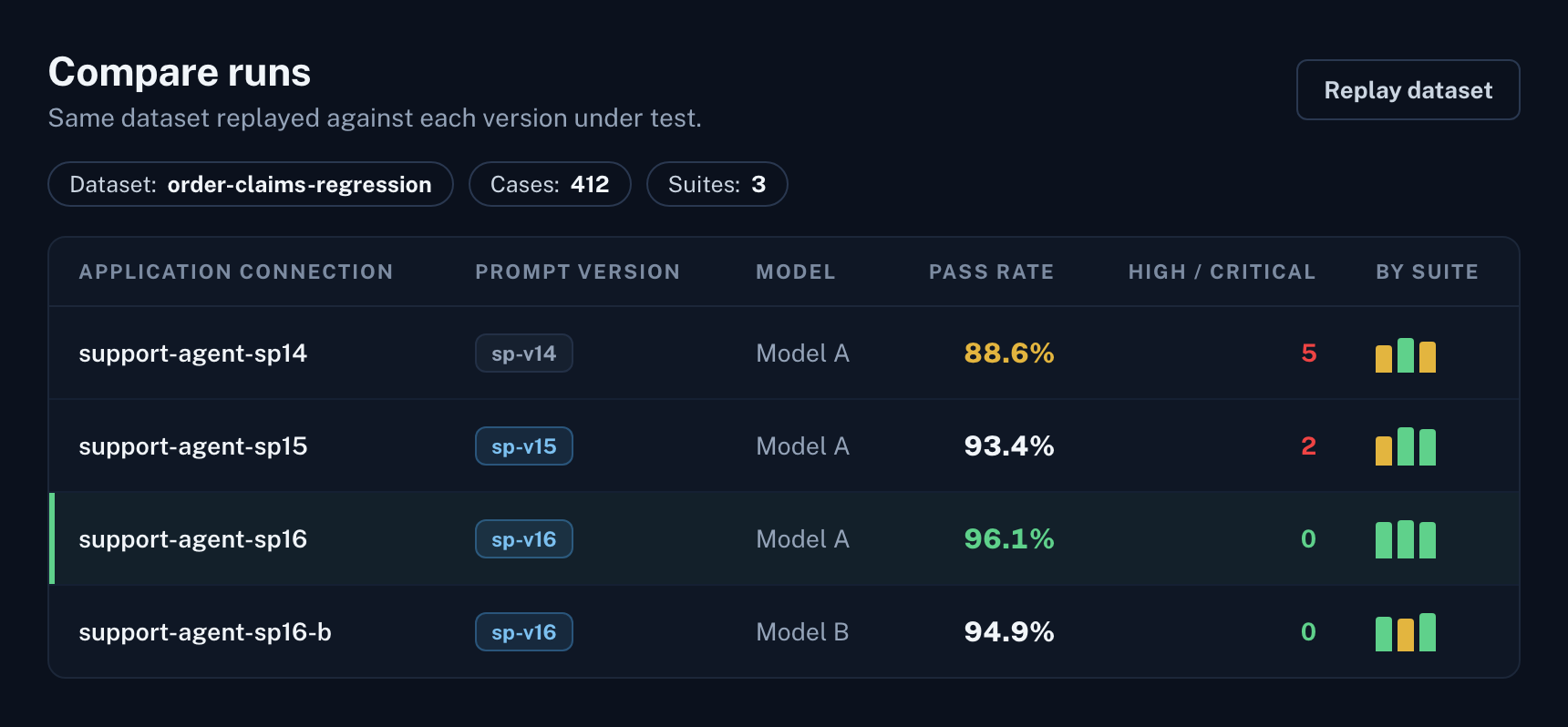
Version, test, and replay prompts
Know which prompt or model version scores better before a release. Tag each test run with the version under test and compare results across runs, or replay the same dataset against two system prompts or models at once.
Model-agnostic evaluation
Bring your model API keys and custom models, and connect to models from OpenAI, Anthropic, AWS Bedrock, Azure OpenAI, or any HTTP endpoint.
Your keys, your models
Bring your model API keys and custom models.
Traces from any agent
Evaluate traces from agents built on any commercial or open-source model.
See it on your traces
Book a walkthrough and see trace evaluation on an agentic application like yours.